
Comparison Of The Applicable Scenarios For Hydraulic Presses of Different TonnagesUpdate:2025-09-23 Hits:333
Hydraulic presses of different tonnages are applicable to various scenarios. Generally, the larger the tonnage, the greater the pressure-bearing capacity, and the more suitable it is for processing larger and harder workpieces. Lower-tonnage presses are suitable for precision tasks and light assembly, while high-tonnage machines are used for heavy-duty industrial applications like deep drawing and forging.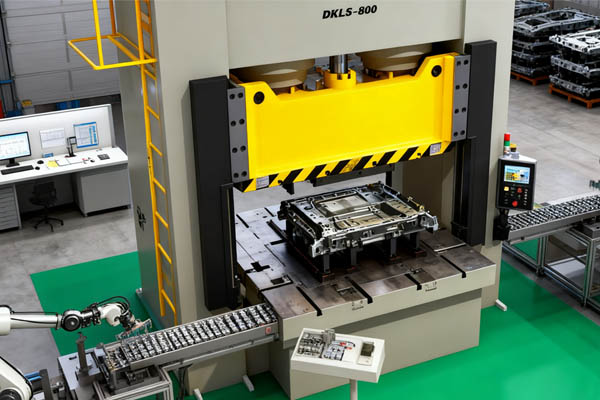
The following is a detailed introduction to the applicable scenarios of hydraulic presses of different tonnages.
10-50 Ton Hydraulic Presses
○ 10-ton hydraulic press: Suitable for some small-scale pressing, punching, pressing, mold adjustment, and slight stretching tasks. For example, in small-scale mechanical workshops, it can be used for pressing small metal parts and punching small holes in thin metal sheets.
○ 50-ton hydraulic press: Applicable to mold pressing, punching, riveting, light metal processing, and plastic product processing. For instance, in the production of small plastic parts, it can be used for mold pressing to shape plastic particles into the required products.
100-300 Ton Hydraulic Presses
○ 100-ton hydraulic press: Suited for the pressing of bull wheel rims, the press-fitting of bearings, the pressing of large spring pieces, and the pressing of non-metals. In the electronic component manufacturing industry, it can be used for the assembly and molding of electronic components.
○ 200-ton hydraulic press: Appropriate for pressing plastic products, medium and small-sized shafts, springs, and molds. In the hardware manufacturing industry, it can be used for the stamping and molding of hardware products, as well as the correction and assembly of medium-sized mechanical parts.
○ 315-ton hydraulic press: With both flexibility and strong pressure, it is applicable to a variety of processing scenarios. It can be used for the stretching and stamping of large metal sheets, the manufacturing of automotive parts such as car doors and bumpers, and the pressing of thick rubber and plastic parts.
500-1000 Ton Hydraulic Presses
○ 500-ton hydraulic press: Suitable for large-scale pressing machinery, mold heat treatment, automotive parts, long-distance torsion and forward and reverse bending of pipes. In the construction materials industry, it can be used for the mold pressing of cement products.
○ 630-ton hydraulic press: With a high-tonnage design, it is suitable for heavy-duty processing scenarios. It is mainly used for the processing of high-strength metal parts, the molding of automotive chassis and structural parts, and the metal sheet processing in the aerospace field.
Above 1000 Ton Hydraulic Presses
○ 1000-ton and above hydraulic press: Applicable to the manufacturing of large pressure vessels, steel plate pressing, forging and forming, deep drawing processing of aluminum alloy parts, and large mold pressing. In the shipbuilding industry, it can be used for the stamping and molding of hull components; in the manufacturing of large-scale mechanical equipment, it can be used for the molding of the casing and frame.
Conclusion
The choice of hydraulic press tonnage depends heavily on part size, material thickness, and production volume.
Low-tonnage presses excel in precision and small parts.
Medium-tonnage presses are the most versatile for industrial production.
High-tonnage presses handle large-scale, complex components.
Ultra-high-tonnage presses serve specialized heavy industries where extraordinary forming capacity is essential.
By matching press tonnage to the right application scenario, manufacturers can ensure efficiency, cost-effectiveness, and consistent product quality.
News
- Hydraulic Press Machines Engineered for Precision & Heavy-Duty Manufacturing2026-09-28
- Hydraulic Press Manufacturer: Precision-Engineered, Automated Solutions2026-09-21
- Hydraulic Press Industry Trends 2026: Automation, Energy Efficiency & Smart Manufacturing2026-09-14
- Custom vs. Standard Hydraulic Presses: Which Is Right for Your Production?2026-09-09
