
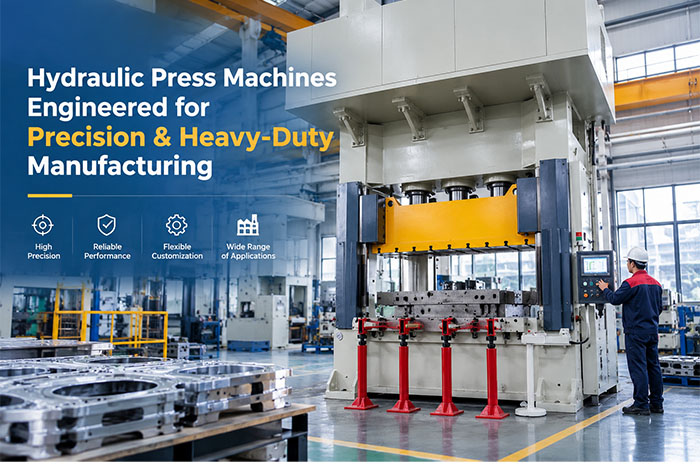
Hydraulic Press Machines Engineered for Precision & Heavy-Duty ManufacturingUpdate:2026-09-28 Hits:34
Modern manufacturing demands more than raw pressing force. Manufacturers need hydraulic press machines that deliver consistent pressure, accurate forming, reliable operation, and the flexibility to handle different production requirements.From precision stamping and deep drawing to forging and heavy-duty forming, hydraulic presses remain essential for industries that require controlled force and repeatable results.
A well-engineered hydraulic press combines high load capacity, rigid machine construction, hydraulic control, precision movement, and automation to create a stable production platform.
What Is a Hydraulic Press Machine?
A hydraulic press machine uses hydraulic pressure to generate a controlled pressing force. Based on Pascal's principle, hydraulic fluid transfers pressure through the system to a cylinder, producing the force required for forming, pressing, stamping, forging, or other manufacturing operations.
Compared with purely mechanical systems, hydraulic presses offer excellent control over:
• Pressing force
• Ram movement
• Working speed
• Stroke length
• Holding pressure
• Return movement
• Forming sequence
This makes hydraulic press machines suitable for both precision manufacturing and heavy-duty industrial applications.
Why Precision Matters in Hydraulic Press Manufacturing
In modern production, pressing force alone is not enough.
A machine may have a high tonnage rating, but the overall manufacturing result also depends on frame stiffness, hydraulic stability, tooling accuracy, control technology, and repeatability.
A precision-engineered hydraulic press can help manufacturers achieve:
Consistent Forming Results
Stable hydraulic pressure and controlled ram movement help maintain consistent forming conditions from one production cycle to the next.
Accurate Stroke Control
Precise control of ram position and stroke can be important for deep drawing, stamping, bending, and other forming processes.
Better Part Quality
Controlled pressure and movement can reduce problems such as uneven forming, excessive deformation, wrinkles, and dimensional variation.
Repeatable Production
For high-volume manufacturing, repeatability is critical. A properly configured hydraulic press can provide stable production performance across thousands of cycles.
Hydraulic Press Machines for Heavy-Duty Manufacturing
Heavy-duty applications require a machine structure capable of handling substantial forming forces.
The press frame, hydraulic cylinder, worktable, guide system, hydraulic circuit, and control system all need to work together as one integrated system.
Depending on the application, hydraulic presses can be configured for demanding operations such as:
• Metal forging
• Cold forging
• Hot forging
• Automotive component forming
• Large-part stamping
• Deep drawing
• Metal bending
• Compression molding
• Powder forming
• Straightening
• Assembly and pressing
The right machine configuration depends on material, part geometry, required force, stroke, working speed, tooling, and production cycle.
Key Features of a High-Performance Hydraulic Press
A modern hydraulic press machine should be engineered around the actual production process rather than simply the required tonnage.
1. Rigid Press Frame
Frame rigidity is essential for maintaining alignment and minimizing deformation under high loads.
A robust frame helps provide a stable platform for the tooling and workpiece, particularly during high-force forming operations.
2. High-Performance Hydraulic System
The hydraulic system controls the generation and transmission of pressing force.
A properly designed system can provide smooth ram movement, stable pressure, and adjustable operating speeds according to different forming requirements.
3. Precision Guide System
The guide structure helps maintain proper ram alignment during movement.
Good alignment is particularly important when manufacturing precision components or operating with large and expensive tooling.
4. Advanced Control System
Modern hydraulic presses can incorporate PLC-based control, touchscreen interfaces, sensors, programmable pressure settings, and automated production sequences.
These technologies make it easier for operators to monitor and adjust machine parameters.
5. Flexible Tooling Integration
A hydraulic press should accommodate the tooling required for the application.
Different production processes may require different die dimensions, bolster configurations, ejector systems, and automated material-handling solutions.
Servo Hydraulic Press Technology for Greater Efficiency
Servo hydraulic technology is becoming increasingly important in modern manufacturing.
A servo hydraulic press combines hydraulic force with intelligent motor and pump control. Instead of continuously operating the hydraulic system at a fixed output, the system can adjust operation according to the actual production requirement.
Potential advantages include:
• More precise motion control
• Adjustable pressing speed
• Improved energy management
• Lower idle energy consumption
• Reduced hydraulic heat generation
• Flexible forming profiles
• Improved process monitoring
Servo hydraulic technology is especially useful when production requires different pressing speeds, controlled dwell times, or highly repeatable forming cycles.
Hydraulic Presses for Precision Stamping and Forming
Stamping and forming applications often require a balance between force, speed, stroke, and repeatability.
Hydraulic presses can provide controlled force throughout the working stroke, making them suitable for applications where forming conditions need to be carefully managed.
Typical applications include:
• Automotive parts
• Metal brackets
• Electrical components
• Appliance components
• Industrial hardware
• Sheet metal products
• Structural components
With appropriate tooling and automation, hydraulic presses can become part of a complete automated forming line.
Deep Drawing with Hydraulic Press Machines
Deep drawing is another important application for hydraulic press technology.
During deep drawing, a sheet-metal blank is formed into a deeper three-dimensional shape using a punch and die.
The process requires careful control of:
• Pressing force
• Drawing speed
• Blank-holder pressure
• Stroke
• Lubrication
• Material flow
Hydraulic presses are well suited to deep drawing because pressing parameters can be controlled throughout the forming cycle.
This makes them suitable for manufacturing components such as tanks, containers, automotive parts, housings, and other deep-formed metal products.
Hydraulic Forging Presses for High-Force Applications
Forging applications demand substantial forming force and reliable machine construction.
Hydraulic forging presses can apply controlled force to metal workpieces during cold, warm, or hot forging processes.
Compared with applications that require only a short pressing action, forging often requires a combination of:
High force + stable frame + controlled stroke + reliable hydraulic performance.
For demanding forging operations, the press must be selected according to material characteristics, workpiece dimensions, required forming force, tooling design, and production volume.
Automation Makes Hydraulic Presses More Productive
Hydraulic press machines are increasingly being integrated into automated production lines.
A modern system may combine the press with:
• Robotic loading and unloading
• Automatic feeders
• Transfer systems
• Die-change systems
• Safety sensors
• Vision inspection
• Part detection
• Automatic lubrication
• Production data monitoring
Automation can reduce manual handling and create a more consistent production process.
For high-volume manufacturing, the combination of hydraulic pressing + automation + process monitoring can significantly improve production efficiency.
How to Choose the Right Hydraulic Press Machine
Selecting a hydraulic press based only on tonnage can result in an unsuitable machine configuration.
Manufacturers should consider the complete application.
Press Force
Determine the required forming or pressing force and allow an appropriate engineering margin.
Stroke Length
The required stroke depends on the workpiece, tooling, and forming process.
Working Speed
Different processes require different ram speeds. Deep drawing, forging, stamping, and assembly applications may have very different speed requirements.
Table Size
The worktable needs to accommodate the tooling and workpiece while providing sufficient working space.
Daylight
The available space between the ram and worktable is important when installing dies and processing larger workpieces.
Accuracy and Repeatability
For precision applications, consider ram positioning, pressure control, guide accuracy, and repeatability.
Automation Requirements
If the press will be integrated into an automated line, the control system, communication interfaces, sensors, and material-handling requirements should be considered during machine design.
Standard Hydraulic Press vs. Customized Hydraulic Press
Not every manufacturing application can be solved with the same machine configuration.
Standard hydraulic presses can be an efficient choice when the production process fits an established machine design.
Customized hydraulic presses may be more appropriate when manufacturers require special:
• Press dimensions
• Stroke lengths
• Working speeds
• Table sizes
• Ejector systems
• Die spaces
• Automation interfaces
• Control functions
• Safety configurations
A customized machine can be engineered around the actual production process instead of forcing the process to fit a standard specification.
Hydraulic Press Applications Across Multiple Industries
The versatility of hydraulic technology makes these machines suitable for many industries.
Automotive Manufacturing
Hydraulic presses are used for forming, stamping, deep drawing, forging, assembly, and production of structural components.
Metalworking
Metal fabricators use hydraulic presses for bending, forming, straightening, pressing, and other high-force operations.
Aerospace
Precision forming and high-strength materials require carefully controlled pressing processes and robust equipment.
Electrical and Electronics
Hydraulic presses can be used for component forming, assembly, lamination, and other controlled pressing applications.
New Energy
Battery-related manufacturing and other new-energy applications increasingly require precise forming, pressing, and assembly processes.
General Industrial Manufacturing
From custom components to heavy-duty industrial parts, hydraulic presses provide a flexible solution for many production environments.
Engineering for Long-Term Reliability
A hydraulic press is a long-term production investment. Machine reliability therefore depends on more than initial specifications.
Important considerations include:
• Structural strength
• Hydraulic component quality
• Electrical control reliability
• Lubrication
• Filtration
• Cooling
• Preventive maintenance
• Operator safety
• Spare parts availability
• Technical support
Regular inspection and preventive maintenance can help identify potential problems before they develop into costly production downtime.
The Future of Hydraulic Press Manufacturing
Hydraulic press technology continues to evolve toward greater precision, automation, energy efficiency, and intelligent control.
Modern machines are increasingly connected to digital manufacturing systems, allowing production parameters and machine conditions to be monitored more effectively.
Technologies such as servo hydraulics, sensors, PLC control, industrial networking, robotic handling, and data monitoring are helping transform conventional presses into smarter manufacturing equipment.
The goal is not simply to build a more powerful press. It is to create a machine that delivers the right force, at the right speed, with the right level of control for the application.
Choose a Hydraulic Press Engineered Around Your Production Needs
The right hydraulic press machine should match your material, tooling, production volume, required force, precision, and automation goals.
Whether the application involves precision stamping, deep drawing, cold forging, hot forging, bending, compression, or heavy-duty forming, a properly engineered hydraulic press can provide the force and process control required for reliable manufacturing.
From standard configurations to customized systems, hydraulic press technology provides manufacturers with a flexible foundation for modern industrial production.
Looking for a Hydraulic Press Machine for Your Application?
Share your material, part dimensions, required tonnage, stroke, production cycle, tooling requirements, and automation needs with our engineering team.
A properly matched hydraulic press solution can help you improve forming consistency, production efficiency, and long-term manufacturing reliability.
Last:Nothing
News
- Hydraulic Press Machines Engineered for Precision & Heavy-Duty Manufacturing2026-09-28
- Hydraulic Press Manufacturer: Precision-Engineered, Automated Solutions2026-09-21
- Hydraulic Press Industry Trends 2026: Automation, Energy Efficiency & Smart Manufacturing2026-09-14
- Custom vs. Standard Hydraulic Presses: Which Is Right for Your Production?2026-09-09
