
How to Ensure Precision In Motion of Hydraulic PressUpdate:2025-12-04 Hits:285
Hydraulic presses are critical equipment in industries like automotive, aerospace, and precision manufacturing, where even microscopic deviations in motion can compromise product quality, tool life, and production efficiency. Ensuring precision in hydraulic press motion requires a holistic approach—combining mechanical design optimization, advanced control systems, and rigorous maintenance practices.The machining process ensures every part of the hydraulic press is crafted to exact specifications, guaranteeing high accuracy and performance. This precision manufacturing improves overall efficiency and longevity.
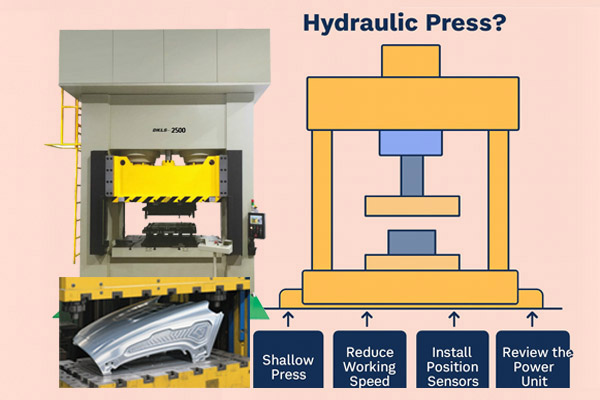
1. Optimize Hydraulic System Design for Precision
The foundation of motion precision lies in the hydraulic system's design, as components like pumps, valves, and cylinders directly influence fluid flow and pressure stability.
1.1 Select High-Precision Hydraulic Components
● Low-Pulsation Pumps: Choose variable-displacement axial piston pumps with pressure compensation. These pumps minimize flow pulsations (typically ≤1% of nominal flow) that cause velocity fluctuations. For example, pumps with servo-controlled displacement mechanisms reduce pressure ripple to ±0.5 bar, ensuring smooth fluid delivery.
● High-Response Servo Valves: Deploy electro-hydraulic servo valves (EHSVs) with fast response times (≤10 ms for 90% step response). Proportional valves with closed-loop feedback are ideal for applications requiring precise flow regulation, such as metal forming where velocity control within ±0.1 mm/s is critical.
● Precision Hydraulic Cylinders: Use cylinders with honed barrels (surface finish ≤0.2 μm Ra) and hardened chrome-plated rods to reduce friction. Integrate piston seals with low friction coefficients (e.g., PTFE-based materials) to minimize stick-slip, a common cause of motion jerks in low-speed operations.
1.2 Minimize Fluid Contamination and Pressure Loss
● Stringent Filtration Systems: Install multi-stage filters (suction, pressure, and return lines) with a filtration rating of 3-5 μm. Contaminants like metal particles or sludge can cause valve sticking and cylinder wear, degrading precision. Regularly monitor filter differential pressure to avoid bypass.
● Optimize Hydraulic Circuit Layout: Shorten hose and pipe lengths to reduce pressure drop (aim for ≤0.5 bar per meter of hose). Use large-diameter lines for high-flow circuits and avoid sharp bends that create turbulence. Incorporate accumulators to dampen pressure spikes and maintain stable system pressure.
2. Implement Advanced Motion Control Technologies
Modern control systems bridge the gap between mechanical design and real-time precision adjustment, enabling dynamic correction of motion errors.
2.1 Closed-Loop Feedback Control
● High-Accuracy Sensors: Integrate linear variable differential transformers (LVDTs) or laser displacement sensors with a resolution of ≤0.1 μm for position feedback. For velocity control, use tachometers or encoder-based speed measurement. These sensors provide real-time data to the controller for error correction.
● PID and Advanced Control Algorithms: Use proportional-integral-derivative (PID) controllers tuned for fast response and minimal overshoot. For complex applications (e.g., multi-axis synchronization), adopt model predictive control (MPC) or adaptive control algorithms that adjust parameters based on load variations. This ensures position accuracy within ±0.01 mm for precision stamping.
2.2 Servo Hydraulic Systems
Upgrade to servo hydraulic presses, which combine hydraulic power with electronic servo control. Unlike traditional hydraulic presses, servo systems use a servo motor to drive the pump, allowing for precise flow and pressure regulation. This reduces energy consumption by up to 30% while improving motion repeatability to ±0.005 mm—critical for micro-forming applications.
3. Enhance Mechanical Structure Rigidity
A rigid frame minimizes deflection under load, a major contributor to motion inaccuracy. Even slight frame bending (e.g., 0.1 mm under full load) can shift the ram’s path and compromise precision.
3.1 Frame Design and Material Selection
● Monoblock or Four-Column Design: Choose monoblock frames for small to medium presses, as they offer higher torsional rigidity. For large presses, use four-column designs with pre-tensioned tie rods to distribute load evenly and reduce deflection. Frame materials should be high-strength cast iron (e.g., GG-40) or welded steel with stress relief heat treatment.
● Ram Guidance Systems: Implement linear guide rails or multi-point slide bearings with minimal clearance (≤0.02 mm). Bronze bushings or hydrostatic guides (which use a thin film of oil for zero-contact motion) further reduce friction and wear, ensuring the ram moves along a straight path.
4. Implement Rigorous Maintenance Protocols
Preventive maintenance is essential to sustain precision over time, as wear and tear on components degrade performance gradually.
4.1 Regular Component Inspection and Replacement
● Seals and O-Rings: Replace hydraulic seals every 6-12 months (or as per manufacturer recommendations) to prevent leaks that cause pressure loss. Use seals compatible with the hydraulic fluid (e.g., nitrile for mineral oil, Viton for high-temperature applications).
● Lubrication: Keep guide rails and moving parts properly lubricated with high-viscosity oils to reduce friction. Implement automatic lubrication systems for consistent oil delivery, avoiding both under-lubrication (wear) and over-lubrication (contamination).
4.2 Calibration and Alignment
Calibrate the press every 3-6 months using laser alignment tools to check ram parallelism, squareness, and position accuracy. Adjust tie rods, guide rails, or servo parameters to correct deviations. For example, ram parallelism should be maintained within 0.05 mm/m to ensure uniform pressure distribution during forming.
5. Control Environmental Factors
Temperature, vibration, and dust can indirectly affect motion precision, especially in high-precision applications.
● Temperature Regulation: Maintain the hydraulic fluid temperature between 40-50°C using coolers or heaters. Temperature fluctuations (e.g., ±5°C) change fluid viscosity, altering flow rates and pressure. Install temperature sensors in the reservoir to trigger cooling/heating systems automatically.
● Vibration Isolation: Mount the press on anti-vibration pads or concrete foundations to absorb external vibrations from nearby equipment. Internal vibrations (e.g., from pump operation) can be dampened with rubber mounts or vibration absorbers.
Conclusion
Ensuring precision in hydraulic press motion is a multi-faceted effort that requires attention to system design, control technology, mechanical rigidity, maintenance, and environmental conditions. By combining high-quality components, advanced servo control, a rigid frame, and proactive maintenance, manufacturers can achieve motion accuracy of ±0.005 mm or better—meeting the demands of even the most stringent precision manufacturing applications. Regular monitoring and calibration further ensure that this precision is sustained throughout the press's operational life.
News
- Hydraulic Press Machines Engineered for Precision & Heavy-Duty Manufacturing2026-09-28
- Hydraulic Press Manufacturer: Precision-Engineered, Automated Solutions2026-09-21
- Hydraulic Press Industry Trends 2026: Automation, Energy Efficiency & Smart Manufacturing2026-09-14
- Custom vs. Standard Hydraulic Presses: Which Is Right for Your Production?2026-09-09
